








Information disclosure based on the TCFD recommendations
The impact of climate change is intensifying every year, and society’s interest in this issue is on the rise, triggering demands that companies step up their actions. The Task Force on Climate-related Financial Disclosures (TCFD), which was established by the Financial Stability Board, published its final report in 2017 that urged companies to disclose information on their climate-related risks and opportunities. Toshiba Tec Group aims to proactively disclose information on climate change in the four areas (Governance, Strategy, Risk Management, and Metrics and Targets) specified by the TCFD.
Toshiba Group has endorsed the TCFD recommendations and is a member of the TCFD Consortium, which aims to promote actions by organizations in Japan in support of the TCFD recommendations.
Governance
At Toshiba Tec Group, for important sustainability issues including climate change, especially key challenges concerning risks and opportunities that affect corporate management of Toshiba Tec Group, policies and action plans to address them are discussed and resolved by the Management Committee meetings and then reported to the Board of Directors. The Board of Directors has the responsibility and authority to supervise risks and opportunities related to overall sustainability. After receiving reports on matters discussed and resolved by the Management Committee meetings, the Board of Directors discusses and supervises the Group’s policies and action plans to address sustainability risks and opportunities. In addition, policies and action plans discussed by the Board of Directors are reflected in the Group’s management strategy, and its progress is managed by the Management Committee and reported to the Board of Directors on a regular basis.
Detailed policies and action plans to address environment-related issues including climate change are discussed at the Management Committee meetings or the Corporate Environmental Conference headed by the President. The conference takes place semiannually, with the participation of each business division’s Environmental Management Officer, the Environmental Promotion Officer, the Corporate Staff Group-related Manager, and the Sustainability and Environmental Affairs Division.
Strategy
Setting Scenarios
In scenario analysis, we set up the following two scenarios:
1.5°C scenario:
For mainly transition risks and opportunities, we use the NZE2050 scenarios created by the International Energy Agency (IEA), assuming a world where the temperature increases by 1.5°C. This scenario predicts increase in costs due to carbon tax, energy-saving related regulations, the introduction of renewable energy, etc., as well as increase in business opportunities due to the growing demand for energy technologies to realize decarbonization and energy-saving products and services.
4°C scenario
For mainly physical risks and opportunities, we use the RCP8.5 scenario by the Intergovernmental Panel on Climate Change (IPCC), assuming a world where the temperature increases by 4°C. Although this scenario does not predict a greater impact of regulations and technology than the 1.5°C scenario, the impact of physical damage such as greater risk of natural disasters like typhoons and flooding caused by unusual weather may increase.
Analysis method
Scope:
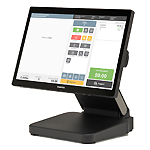
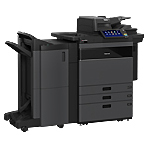
We perform scenario analysis for both our Retail Solutions Business Groups and Workplace Solutions Business Groups in order to identify the risks and opportunities specific to each business. Not stopping at the initiatives of our own company, the analysis covers the entire value chain including the upstream (suppliers) and downstream (customers, users).
Time frames:
Three time frames are set (short-, medium-, and long-terms). Short-term covers 0 to 3 years later, medium-term covers 4 to 1 0 years later (up to FY2030), and long-term covers 11 to 30 years later (up to FY2050)
Analysis steps:
We conduct scenario analysis in line with the steps, “Risk importance assessment,” “Definition of scenario groups,” “Business impact assessment,” and “Definition of countermeasures” based on the TCFD recommendations. In the latest scenario analysis, we will conduct analysis in the business areas listed in the “Scope” above, evaluate the level of importance, and proceed to consider countermeasures for those of high importance and priority.
Analysis results
The main results of the latest scenario analysis of our risks and opportunities are as follows.
Risks common to Retail and Workplace
| Type | Risks or opportunities | Time frames | Response | ||
|---|---|---|---|---|---|
| Risks | Transition Risks | Policy and Legal |
|
Short-to medium-term |
|
|
Medium-term |
|
|||
|
|
||||
|
Short-to medium-term |
|
|||
| Technology |
|
Medium-term |
|
||
|
|
||||
|
Short- to medium-term |
|
|||
| Market |
|
Medium-term |
|
||
|
|
||||
| Reputation |
|
Medium-term |
|
||
| Physical Risks | Acute |
|
Long-term |
|
|
|
|
||||
| Chronic |
|
Long-term |
|
||
Opportunities in the Retail Solutions Business
| Type | Risks or opportunities | Time frames | Response | |
|---|---|---|---|---|
| Opportunities | Products & Services, Market |
|
Medium-term |
|
|
|
|||
|
|
|||
Opportunities in the Workplace Solutions Business
| Type | Risks or opportunities | Time frames | Response | |
|---|---|---|---|---|
| Opportunities | Products & Services, Market |
|
Short- to medium-term |
|
|
Medium-term |
|
||
Response Measures
The measures to address the risks and opportunities identified and evaluated in the above scenario analysis will be incorporated as part of future medium-term business plans in each business area, and progress will be managed on a regular basis.
Response to climate change has also been set as a priority item in our Toshiba Group’s Environmental Future Vision 2050. In addition, since most of the GHG emissions in the entire value chain of Toshiba Tec Group are generated during the use of our products and services, we will take appropriate measures such as improving the energy-saving performance of our products and services and expanding businesses that are compatible with a decarbonized society. We will continue to incorporate the results of scenario analysis into Toshiba Tec Group’s business strategies to ensure sustainable corporate management while appropriately responding to the risks and opportunities of climate change.
Risk Management
Toshiba Tec Group’s risk management related to climate change is integrated into the company-wide risk management process. For each matter that could majorly impact the Group’s management, including climate change-related risk, the Business Risk Review Committee conducts risk assessment, and then those considered to be of particularly high concern from the perspective of business risk are discussed at Management Committee meetings. Moreover, all risks and opportunities evaluated and identified as relating to climate change are shared through the Corporate Environmental Conference and managed under the above-mentioned promotion system.
Indicators and Targets
Toshiba Tec Group is aiming to achieve carbon neutrality by FY2050 throughout the value chain. Also, as milestones, we have set the below targets and are striving to achieve them by FY2030.
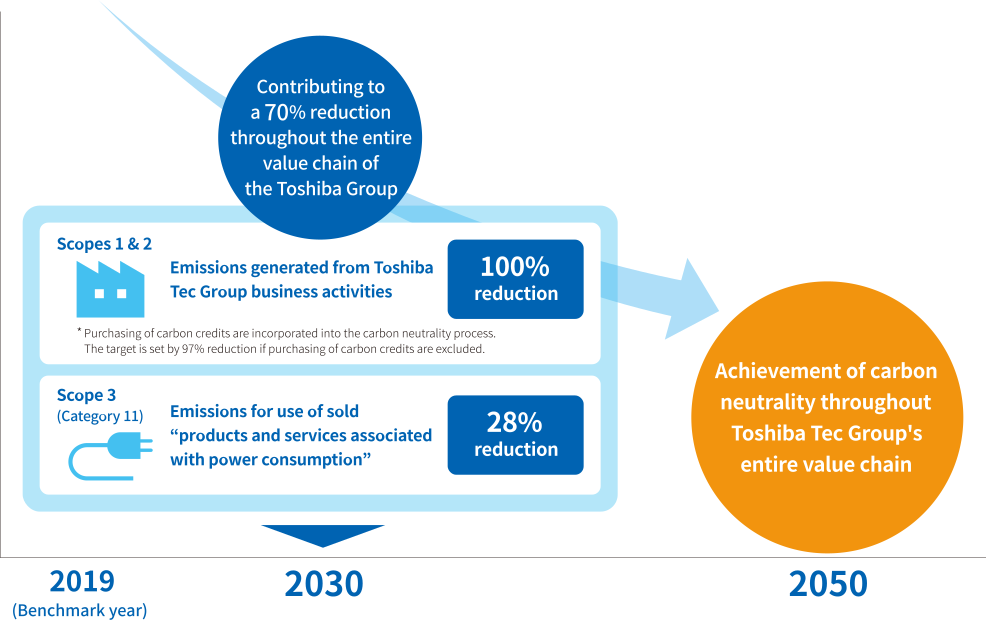
Reduce the total of Scope 1※1 and Scope 2※2 (GHG emissions generated from Toshiba Tec Group business activities) by 100% by FY2030.
*Purchasing of carbon credits is incorporated into the carbon neutrality process. The target is set at 97% reduction if the purchasing of carbon credits is excluded.
Reduce GHG emissions for use of sold “products and services associated with power consumption”*3 sold in Scope 3*4 by 28% by FY2030.
*1 Direct GHG emissions via the use of fuel at Toshiba Tec Group
*2 Indirect GHG emissions via the use of power and heat purchased by Toshiba Tec Group
*3 Retail and printing products, etc.
*4 Indirect GHG emissions other than Scopes 1 & 2 that arise from Toshiba Tec Group's value chain (raw material procurement, logistics, sale, disposal, etc.)
Corporate Data
-
- Topics
- CEO Message
- Message from Chief Sustainability Officer
- Toshiba Tec Group Sustainability Policy and Materiality KPI
- Special Feature SDGs x Toshiba Tec
-
Environment
- Information disclosure based on the TCFD recommendations
- Basic Policy / Vision / Strategy
- Promoting environmental management harmonized with business operations
- Offering of Environmentally Conscious Products and Services
- Reduction of environmental impact in business activities
- Social
- Governance
- Feature: 5-Minute Guide—Toshiba Tec CSR Activities
- Integrated Report